This massive, tiered wall of water is so wide it requires two countries to share it, with the international border running right through the middle of the river.
About Ban Gioc Waterfall
Ban Gioc is the fourth-largest border waterfall in the world, sharing its geography with the Detian Falls on the Chinese side. For generations, the falls were known only to the local Tay minority and a handful of intrepid explorers who braved the rugged northern terrain. During the brief border conflict in 1979, the area was a closed military zone, and its beauty was hidden from the public for years. It wasn't until the late 1990s that the first trickle of tourists began to arrive, drawn by the photographs of the limestone karsts that characterize this part of the Cao Bang Geopark. Today, it is the centerpiece of a UNESCO Global Geopark, protected for its unique geological formations and its role as a vital water source for regional agriculture.
What Ban Gioc Waterfall actually is
Thundering curtains of white water drop through a series of limestone tiers, straddling the international border between Vietnam and China. Ban Gioc Waterfall is a titanic natural spectacle, powered by the Quay Son River as it spills over a 300-meter-wide precipice in the remote northern province of Cao Bang. The falls are framed by sharp karst peaks and lush groves of bamboo, creating a landscape that looks more like a classical ink painting than a modern tourist site. Unlike the vertical plunges of other famous falls, Ban Gioc is a layered masterpiece, with water weaving through trees and over mossy rocks in a chaotic, beautiful sprawl. On the water, small bamboo rafts navigated by poles bring visitors to the very edge of the mist, where the political boundary is marked only by a line in the riverbed.
“Thundering curtains of white water drop through a series of limestone tiers, straddling the international border between Vietnam and China.”
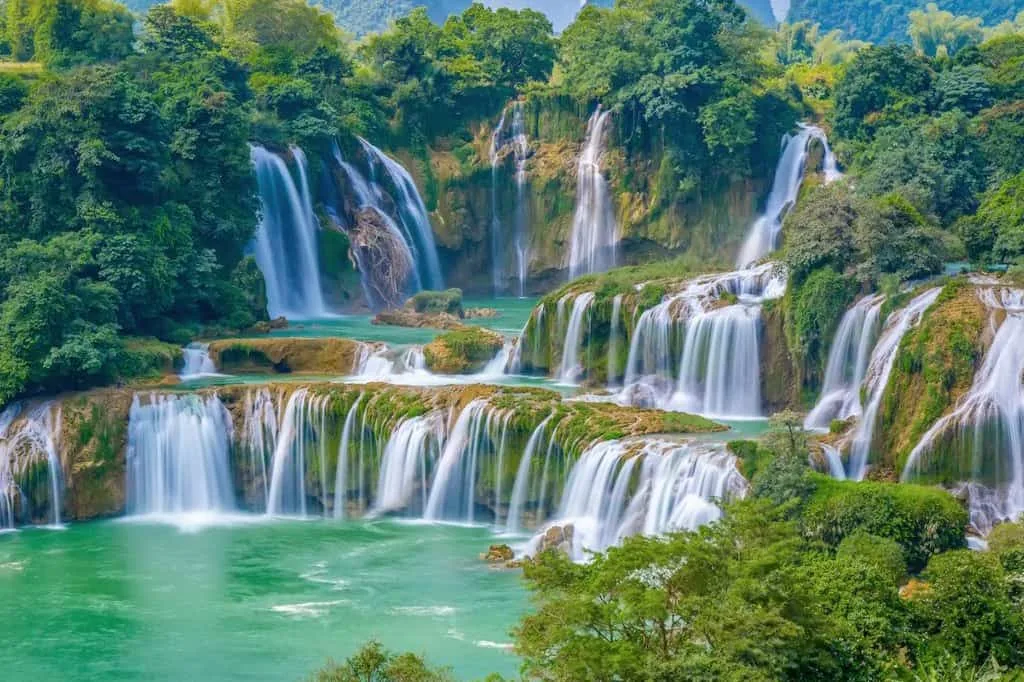
Ban Gioc Waterfall, Vietnam
The falls have long been
The falls have long been a point of pride and occasional tension, as the exact middle of the river is the dividing line between Vietnam and China. Over the centuries, the Tay ethnic people have lived in the surrounding valleys, farming rice and fishing in the pools below the falls. The area was a remote backwater for much of the 20th century, largely inaccessible due to poor roads and the sensitivity of the border zone. In recent years, a joint agreement between the two nations has allowed for increased tourism, though the presence of border guards on both banks echoes of the site's geopolitical weight. Despite the growing infrastructure, the falls remain surprisingly wild, untainted by the massive commercial developments seen at other major Asian landmarks.
The air is perpetually cool and saturated with a fine, refreshing mist that coats everything in a glistening sheen. From somewhere comes the deep, multi-tonal roar of the water, a sound that vibrates in your chest approaching the base of the main drop. Down the muddy riverbank, The dampness of the air and the spray that hits your face with the force of a light rain. Leading with the vibrant green of the moss and ferns that cling to the wet rocks, thriving in the constant humidity. The light at sunrise is particularly ethereal, as the sun clears the karst peaks and illuminates the mist, creating fleeting rainbows in the spray. From a bamboo raft at the foot of the falls, the sheer volume of water cascading above you makes the world feel small and brilliantly loud. Reaching Ban Gioc requires a journey into the far northeast of Vietnam, typically involving a seven-hour drive from Hanoi to Cao Bang city, followed by another two hours to the border. People typically hire a private car or join a small-group tour, as the mountain roads are winding and require an experienced driver. Because the falls are located directly on the border, visitors must purchase a permit at the entrance, and carrying a passport is mandatory. The final approach to the falls involves a short walk through rice fields and over small wooden bridges, bringing you to the riverbank where the rafts wait to ferry you into the heart of the mist.
The Experience
You feel a rush of adrenaline as your raft pilot poles you closer to the thundering base of the falls, where the wind from the water is strong enough to blow back your hair. Audibly, the is a constant, low-frequency rumble that makes conversation nearly impossible. What registers is the Chinese tourists on identical rafts just a few meters away, waving across the invisible border line. The majority stay at the bottom, but the real secret is the path that leads to the upper tiers, where you can find quiet pools tucked away from the main spray. The moment the sun hits the water at the perfect angle and turns the entire face of the falls into a shimmering wall of silver is when you realize why this is considered the most beautiful spot in the north.
Why It Matters
Ban Gioc is a natural marvel of the Southeast Asian karst landscape and a significant symbol of cross-border cooperation. It is the heart of the Cao Bang UNESCO Global Geopark, representing millions of years of river erosion through soluble limestone. Humanly, it is a site where the rigid concept of international borders dissolves into the shared beauty of a single river.
Why Visit
Visit Ban Gioc because it offers a raw, powerful beauty that has yet to be fully tamed by the tourism industry. It is a journey to the edge of the world, offering a combination of dramatic geology and serene rural life. You go for the scale of the water, but you stay for the incredible stillness of the surrounding mountains.
Insider Tips
- 1
Bring your passport to the ticket office; since the falls sit on the Chinese border, local police frequently check identification for all visitors.
- 2
Take the bamboo raft ride; it is the only way to get close enough to the falls to feel their true power and see the hidden caves behind the water curtain.
- 3
Stay in a local guesthouse in the nearby village of Khuoi Ky, famous for its unique stone houses, to experience the area after the day-trippers leave.
- 4
Wear sturdy, waterproof sandals with good grip, as the paths around the river are perpetually muddy and the rocks are covered in slick moss.