This cave is so enormous that a 40-story New York skyscraper could fit inside its largest chamber without touching the ceiling.
About Son Doong Cave
Son Doong remained hidden from the world for millions of years due to its remote location and the sheer verticality of its entrance. When the British Cave Research Association finally mapped it in 2009, they realized it eclipsed Malaysia’s Deer Cave as the world's largest. The cave contains fossils and geological formations that provide a unique timeline of the region's seismic history. Its discovery turned the sleepy region of Quang Binh into a global destination for adventure tourism, yet it remains one of the most exclusive and protected natural sites on Earth. The 'Great Wall of Vietnam' was only conquered during the second expedition in 2010, which finally allowed researchers to see the cave's exit and confirm its total length.
A cave so vast that it possesses
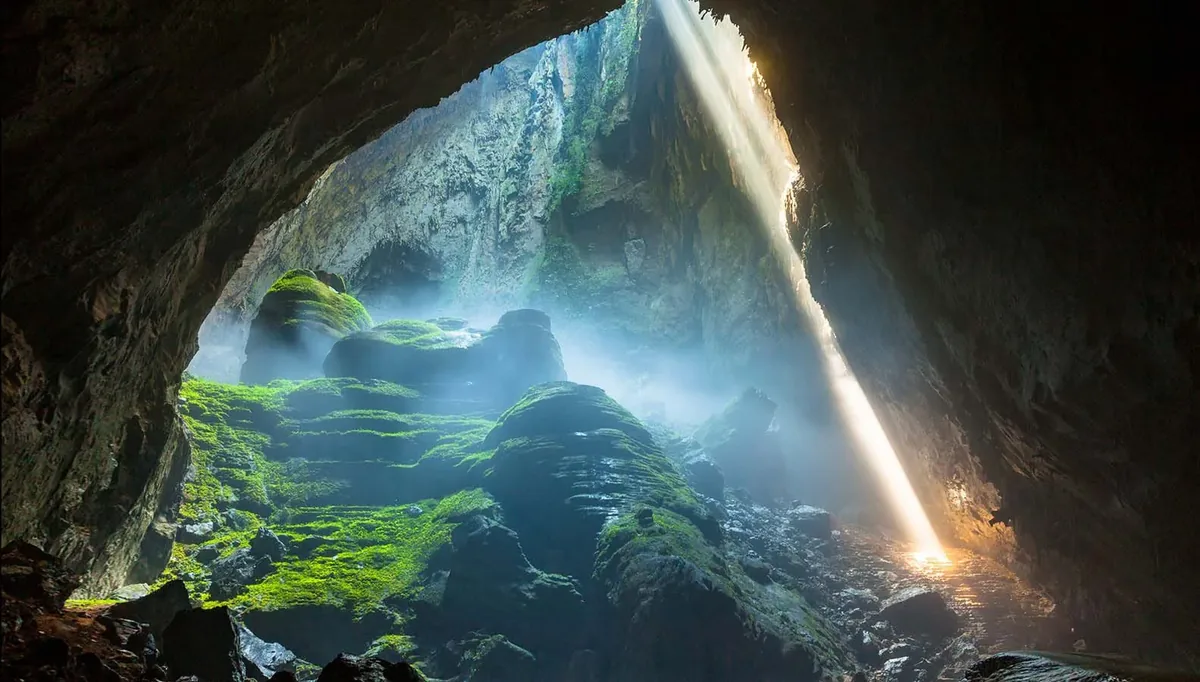
A cave so vast that it possesses its own localized weather system and clouds, Son Doong is a subterranean world that defies the laws of human perspective. Hidden deep within the limestone heart of Phong Nha-Ke Bang National Park, it is officially recognized as the largest cave passage in the world by volume. Entering this space is less like traditional caving and more like stepping onto another planet; some chambers are large enough to house a forty-story skyscraper or a Boeing 747. The cave is defined by two massive 'dolines', collapsed ceilings that allow shafts of sunlight to penetrate the darkness, fostering a lush jungle known as the Garden of Edam. Massive stalagmites, some reaching seventy meters in height, rise from the floor like jagged monuments in a silent, underground city.
discovered the entrance, 1991
Local man Ho Khanh discovered the entrance in 1991 while searching for timber, but the roar of the underground river and the steep descent kept him from exploring further. He lost the location for nearly two decades until British cavers Howard and Deb Limbert encouraged him to find it again in 2009. Their subsequent expedition revealed a passage nearly nine kilometers long with a cross-section of 150 by 200 meters. Geologically, the cave is relatively young at three million years old, carved by the Rao Thuong River as it dissolved the soluble limestone along a fault line. To preserve its fragile ecosystem, the Vietnamese government limits visitors to just a few hundred per year, all managed through a single highly regulated expedition company.
Visiting Son Doong Cave
The air changes instantly at the entrance, shifting from the tropical heat of the jungle to a cool, damp breeze that smells of wet sand and ancient minerals. You catch is the constant, thunderous rumble of the subterranean river and the eerie, rhythmic drip of water from ceilings hundreds of feet above. Scrambling over the 'Great Wall of Vietnam', a ninety-meter calcite barrier, the slick, cold texture of the flowstone beneath your gloves. Leading with the 'cave pearls' in the limestone pools, perfectly round stones formed by centuries of dripping water. The light at the dolines is surreal, a laser-like beam of sun that illuminates the mist and turns the underground ferns a brilliant, glowing neon green. In the middle of a chamber the size of a stadium, the silence of the deep earth is almost deafening.
Reaching the cave is an odyssey
Reaching the cave is an odyssey that begins with a flight to Dong Hoi, followed by a drive into the remote village of Phong Nha. The actual journey to the cave requires a multi-day trek through the dense jungle of the national park, including river crossings and a visit to the ethnic minority village of Ban Doong. Because of its extreme size and technical difficulty, access is strictly limited to guided expeditions that include a team of porters, cooks, and safety experts. There are no roads or easy paths; you must earn your entrance to Son Doong through physical endurance and a willingness to be completely off the grid.
The Experience
There is a profound sense of isolation as your headlamp beam is swallowed by the void, unable to reach the walls of the largest chambers. The clatter of your own heartbeat becomes a companion in the silence between the river's roars. First, the unique flora that grows nowhere else on earth, adapted to the dim light of the dolines. Just about everyone imagine a cave as a cramped space, but here, the ceiling is so high that you often forget you are underground. The moment you see the mist rising from the Garden of Edam under a shaft of light, it feels as if you have found the center of the world. It is a place that makes the concept of time feel irrelevant.
Why It Matters
Son Doong is a geological masterpiece and a biological frontier. It represents the ultimate boundary of terrestrial exploration, being one of the last 'great' places on Earth to be mapped by humans. Culturally and economically, it has become a symbol of Vietnam's commitment to high-value, sustainable eco-tourism over mass development.
Why Visit
Visit Son Doong because it is the rarest travel experience on the planet. It offers a scale of natural wonder that challenges your understanding of what the Earth is capable of creating. You go to experience a world that only a few thousand humans have ever seen, in a place where nature still holds all the power.
✦ Photo Gallery
Best Season
🌤 February to August is the only window for visits, as the monsoon rains from September to January cause the underground river to rise, making the cave inaccessible and deadly.
Quick Facts
Best time to visit
February to August is the only window for visits, as the monsoon rains from September to January cause the underground river to rise, making the cave inaccessible and deadly.
Getting there
In Phong Nha, Vietnam; reach Phong Nha first, then continue to the site.
Location
Phong Nha, Vietnam
Type
attraction
Insider Tips
- 1
Train your cardiovascular endurance for months before arriving; the jungle trek to get to the cave is just as grueling as the caving itself.
- 2
Invest in high-quality, quick-drying boots with excellent grip, as you will be walking through water and over slippery calcite for days.
- 3
Book your expedition at least a year in advance, as the strictly limited permits sell out almost instantly when released.
- 4
Do not bring a heavy tripod; the porters carry your gear, but light and fast is the rule for navigating the technical sections of the cave.
- 5
Listen closely to the safety briefings about the 'Great Wall of Vietnam'; the ascent requires a harness and a calm head for heights.