Imagine a cathedral where Victor Hugo is a saint, dragons climb the pillars, and a giant blue eye watches you from the ceiling in a riot of technicolor paint.
About Cao Dai Holy See
The Cao Dai Holy See is more than a temple; it was once the capital of a mini-state that functioned independently during the mid-20th century. Built on a site that was once a dense forest, the complex was constructed by volunteers who saw the work as a form of prayer. The design was dictated by divine revelations received by the faith's founders, which explains the surreal mix of architectural styles. During the 1950s, the Holy See was a site of intense political intrigue, as the Cao Dai leadership navigated the dangerous waters between colonial powers and revolutionary forces. Today, it works as a monument to the unique religious pluralism that defines the southern Vietnamese spirit.
Technicolor dragons wrap around pink columns inside
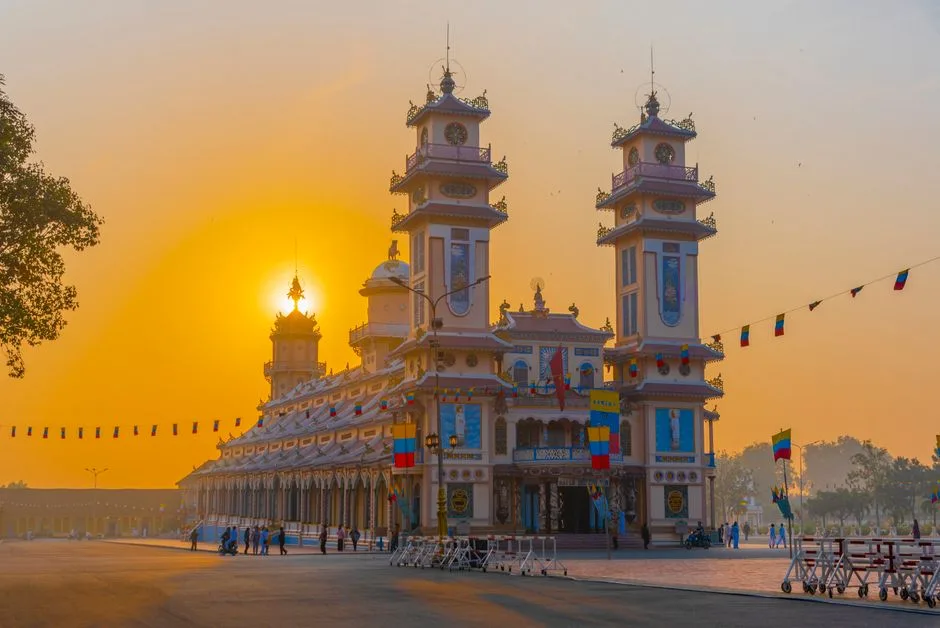
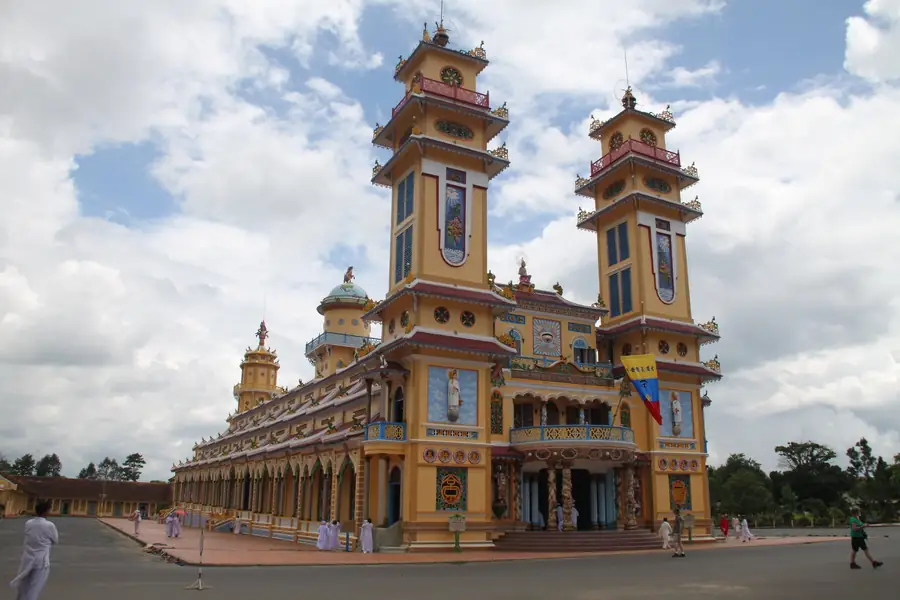
Technicolor dragons wrap around pink columns inside a cathedral that looks like a collaboration between a French architect and a psychedelic artist. The Cao Dai Holy See in Tay Ninh is the spiritual headquarters of Caodaism, a home-grown Vietnamese religion that attempts to fuse the world’s great faiths into a single path. The architecture is a wild, joyful collision of a Catholic cathedral’s nave, the minarets of a mosque, and the sweeping eaves of a Buddhist pagoda. Everything is painted in vibrant primary colors, and the ceiling is a deep sky-blue, dotted with fluffy white clouds and stars. At the far end of the sanctuary, a massive blue globe painted with a single, all-seeing eye stares back at the congregation, representing the divine heart of the universe and the unity of all mankind.
“Technicolor dragons wrap around pink columns inside a cathedral that looks like a collaboration between a French architect and a psychedelic artist.”
Cao Dai Holy See, Vietnam
Caodaism was founded, 1926
Caodaism was founded in 1926 by a group of Vietnamese civil servants who claimed to have received messages from the spirit world during seances. They sought to create a 'universal' religion that counted Victor Hugo, Joan of Arc, and Sun Yat-sen among its saints, alongside Jesus, Buddha, and Confucius. The Holy See was built between 1933 and 1955, surviving the turbulent years of the French Indochina War and the Vietnam War. During the conflict, the Cao Dai even maintained their own private army to protect the province from both the communists and the Americans. Despite being suppressed after 1975, the faith has seen a massive resurgence, and the Holy See remains the pulsing heart of a movement that now claims over four million followers worldwide.
The air inside the Great
Temple is surprisingly still and carries the faint, sweet scent of sandalwood incense and lilies. The hypnotic, high-pitched melody of a traditional Vietnamese orchestra playing from the balcony, punctuated by the rhythmic strike of a wooden block. Tracing the upper balcony reserved for visitors, the smooth, cool wood of the railings and the heat rising from the hundreds of worshippers below. What you catch first is the strict color coding of the robes, yellow for Buddhists, blue for Taoists, and red for Confucians, all moving in perfect, silent unison. The light floods in through windows shaped like lotus flowers, illuminating the golden scales of the dragons that climb the pillars. Standing above the sea of white-clad followers during the noon ceremony, the visual symmetry of the prayer creates a feeling of profound, orderly peace.
Tay Ninh lies about ninety
Tay Ninh lies about ninety kilometers northwest of Ho Chi Minh City, a journey that usually takes between two and three hours depending on the chaotic traffic of the suburbs. People typically visit as part of a day trip that often includes the Cu Chi Tunnels. To see the most important daily ceremony, you must be inside the temple by 12:00 PM. Visitors are required to remove their shoes and are directed to the upper balconies to watch the prayer without disturbing the worshippers. Conservative dress is mandatory, meaning shoulders and knees must be covered, though the atmosphere is generally welcoming to those who follow the rules of the house.
“Tay Ninh lies about ninety kilometers northwest of Ho Chi Minh City, a journey that usually takes between two and three hours depending on the chaotic traffic of the suburbs.”
The Experience
The sense of sheer visual overload as you step through the doors and see the pink and turquoise colonnade stretching into the distance. The sound of the choir is thin and haunting, floating over the silent, kneeling congregation like a mist. Right away you see how the followers enter through different doors depending on their gender, moving with a grace that suggests years of practice. People generally are busy trying to photograph the colors, but the real impact is the absolute silence of the crowd when the music stops. The moment the all-seeing eye catches your gaze from the top of the globe is when the strangeness of the place turns into something genuinely spiritual.
Why It Matters
The Holy See is the definitive monument of Caodaism, the third-largest religion in Vietnam. It represents a fascinating cultural attempt at global synthesis, reflecting Vietnam’s history as a crossroads of eastern and western thought. Historically, it is a rare example of a 20th-century religious movement that successfully built an enduring architectural and social legacy.
Why Visit
Visit the Cao Dai Holy See because it is unlike any other religious building on the planet. It is a masterclass in symbolism and a vivid reminder that faith can be colorful, inclusive, and even a little bit eccentric. You go for the 'Disney-esque' architecture, but you stay for the moving display of devotion from the millions of followers who keep this universal dream alive.
Insider Tips
- 1
Arrive at the temple at least 30 minutes before the noon ceremony to secure a spot at the front of the balcony for the best view of the robes.
- 2
Avoid wearing white clothing; this color is reserved for the followers, and wearing it can cause confusion or be seen as a minor faux pas.
- 3
Walk around the exterior of the temple first to see the intricate tiles and the various towers before the crowd gathers for the prayer service.
- 4
Be prepared for a long day if you are coming from the city; bring water and snacks as the area around the temple has limited tourist-friendly dining.