Inside the world's largest Chinatown, a single market built by a Chinese philanthropist handles enough wholesale goods every morning to fill a small mountain.
About Cho Lon (Bin Tay Market)
Cho Lon was a city within a city long before Saigon became a mega-metropolis. It was the center of the rice trade and a notorious hotspot for opium dens and gambling during the colonial era. Quach Dam, the man who funded the Binh Tay Market, was a rags-to-riches legend who started as a scrap metal collector and ended as one of the wealthiest men in Indochina. His contribution provided the community with a permanent, organized space for trade that anchored the district's economy. Even after the political upheavals of the 20th century, the market's role as a wholesale giant has never wavered, serving as the bridge between regional producers and urban consumers.
A sea of ochre-colored tiles and a Chinese-style
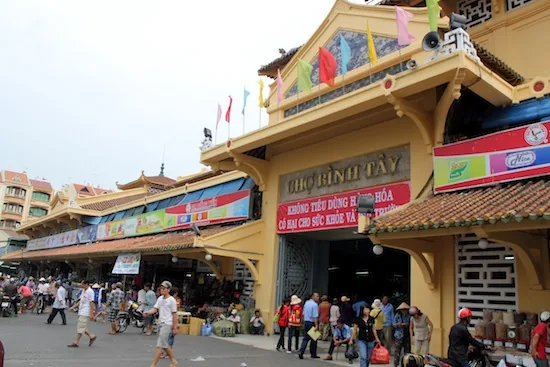
A sea of ochre-colored tiles and a Chinese-style clock tower rise above the chaos of Ho Chi Minh City’s District 5, marking the center of the world's largest Chinatown. Cho Lon, and its architectural centerpiece, the Binh Tay Market, is a feverish hub of wholesale trade where It smells of star anise and dried shrimp. The market was built with a wide central courtyard and airy corridors to allow for better ventilation, a necessity in the sweltering southern heat. While the central Ben Thanh Market in District 1 has become a polished tourist destination, Cho Lon remains a gritty, authentic powerhouse of commerce. Here, porters navigate narrow aisles with stacks of boxes that defy gravity, and the business of the city is conducted in a rapid-fire blend of Cantonese and Vietnamese.
The name Cho Lon literally translates
The name Cho Lon literally translates to 'Big Market,' and it began as a separate settlement founded by Hoa (ethnic Chinese) refugees who fled conflict in the 17th century. They transformed a swampy riverbank into a wealthy merchant enclave that eventually merged with the growing city of Saigon. Binh Tay Market was built in the 1920s by a wealthy Chinese businessman named Quach Dam, whose statue still presides over the central courtyard. The market’s design was revolutionary for its time, featuring a mix of traditional Chinese motifs and French colonial structural elements. It has survived fires, urban renewal, and the massive exodus of the Hoa people in the late 1970s, remaining the primary distribution point for almost everything sold in southern Vietnam.
Visiting Cho Lon (Binh Tay Market)
The air is a heavy, intoxicating fug of roasting coffee, medicinal herbs, and the sharp tang of fermented fish sauce. The relentless, metallic clatter of handcarts over concrete and the rhythmic 'thwack' of heavy cleavers in the wet market sections. Through the fabric aisles, The textures of thousands of bolts of silk and polyester, a soft contrast to the hard, gritty energy of the street outside. Right off, the small, red altars tucked into the corners of every stall, where incense smoke curls around offerings of fruit and fake money. The light in the central courtyard is bright and harsh, illuminating the weathered faces of the porters who have worked these aisles for decades. At the edge of the market at dawn, the sight of hundreds of motorbikes being loaded with everything from live chickens to plastic chairs is a masterclass in urban logistics.
Cho Lon is located about five
Cho Lon is located about five kilometers west of the city center, reachable by a fifteen-minute taxi or a local bus ride from the Ben Thanh terminal. The area is best explored on foot, though the sidewalks are non-existent, and you must share the road with a constant stream of delivery vehicles. Exploring the surrounding streets is as important as the market itself, as the neighborhood is home to some of the city’s most beautiful and atmospheric Chinese pagodas, including the Thien Hau Temple, which is just a short walk away from the market’s main entrance.
The Experience
You feel the raw, unedited energy of Saigon the moment you step into the shadow of the Binh Tay clock tower. The sound is a constant roar, the shouting of prices, the honking of bikes, and the hum of a thousand private conversations. The way the light catches the dust motes in the high-ceilinged corridors, giving the market an almost cathedral-like quality in the early morning. Those who come find the pace overwhelming, but the real trick is to find a small noodle stall on the perimeter and just watch the machinery of the city move. The moment you find a quiet pagoda nearby and smell the coils of incense, the frantic energy of the market suddenly makes perfect sense.
Why It Matters
Cho Lon is the epicentre of the Hoa (ethnic Chinese) culture in Vietnam. It represents the historical and ongoing importance of the Chinese diaspora in the country’s economic development. Binh Tay Market is not just a building; it is a monument to the resilience of immigrant communities and their ability to shape the urban fabric of their new home.
Why Visit
Visit Cho Lon because it is the most visceral experience of commerce in Southeast Asia. It is a place where you can lose yourself in the smells and sounds of an ancient trade route that has simply been updated for the modern world. You go for the architecture, but you stay for the feeling of being in the middle of a city that never stops moving.
✦ Photo Gallery
Best Season
🌤 January and February are the most atmospheric months, as the district goes into a decorative frenzy for the Lunar New Year (Tet), with flower markets and lion dances taking over the streets.
Quick Facts
Best time to visit
January and February are the most atmospheric months, as the district goes into a decorative frenzy for the Lunar New Year (Tet), with flower markets and lion dances taking over the streets.
Getting there
In Ho Chi Minh City, Vietnam; reach Ho Chi Minh City first, then continue to the site.
Location
Ho Chi Minh City, Vietnam
Type
attraction
Insider Tips
- 1
Head to the second floor of Binh Tay Market to get a bird's-eye view of the courtyard and the incredible geometry of the tile roof.
- 2
Don't try to shop for single souvenirs here; this is a wholesale market where most vendors only sell in bulk, though you can find great deals on dried fruits.
- 3
Visit the nearby Thien Hau Temple after the market to see the massive coils of incense that burn for weeks at a time.
- 4
Keep a firm grip on your bags and pockets; the density of the crowds makes it a prime spot for opportunistic pickpockets.
- 5
Eat lunch at one of the duck noodle stalls on Ha Ton Quyen Street, which are legendary for serving the best Chinese-style dumplings in the city.