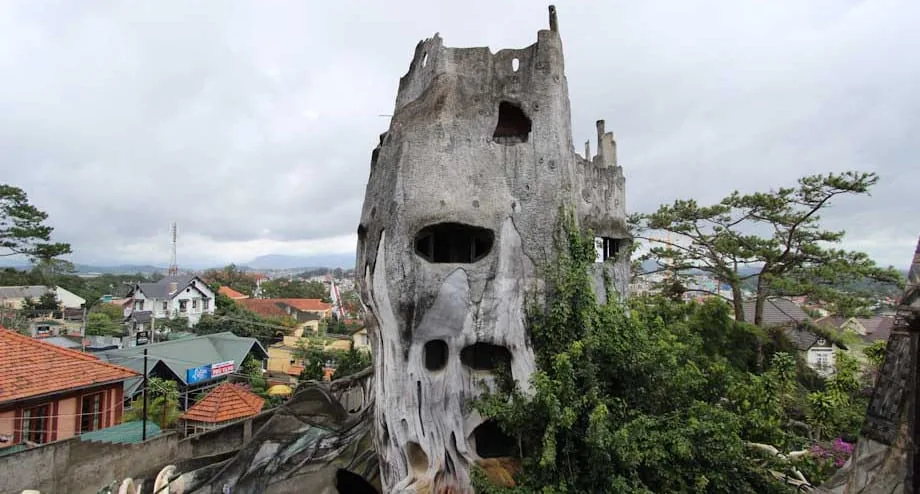
An architect with a PhD from Moscow decided to build a giant concrete banyan tree in the mountains, then realized she needed to charge admission to finish her dream.
About Hang Nga Guesthouse
Dang Viet Nga returned to Vietnam after years in Russia, bringing a vision that many locals thought was literal madness. She began pouring concrete without traditional blueprints, relying instead on paintings to guide the workmen who shaped the liquid stone by hand. Throughout the 1990s, the project was a point of intense controversy among Da Lat’s building planners, who repeatedly tried to shut it down. Only Nga’s persistence and her family's historical standing kept the cement mixers running. Today, the building is recognized globally as a masterpiece of expressionist architecture, often compared to the works of Gaudí or Salvador Dalí, though it remains distinctly Vietnamese in its whimsical spirit.
What Hang Nga Guesthouse actually is
Twisted concrete vines and melted-wax windows define the skyline of a quiet residential neighborhood in Da Lat, defying every law of linear architecture. Hang Nga Guesthouse, widely known as the Crazy House, functions as a living sculpture that travelers can actually sleep inside. The structure mimics a giant, decaying banyan tree, with narrow sky-bridges that snake over rooftops and staircases that spiral through hollowed-out trunks. Instead of standard hotel hallways, finding cavernous passages and themed guest rooms named after animals like the tiger, the eagle, or the ant. Every corner feels intentional yet chaotic, a deliberate rebellion against the boxy, functional buildings that dominate modern urban planning. It is a playground for the imagination where the boundary between the natural world and man-made art dissolves into a phantasmagoria of grey stone and vibrant stained glass.
this passion project, 1990
Dang Viet Nga, a Moscow-trained Vietnamese architect with a penchant for surrealism, began this passion project in 1990. As the daughter of a former President of Vietnam, she possessed the political capital to push through a design that local authorities initially found baffling and subversive. She sought to reconnect people with nature, moving away from the rigid right angles of the Soviet-influenced architecture she had studied. Financial struggles nearly halted the project several times, leading Nga to open the house to tourists as a guesthouse to fund the ongoing construction. Decades later, the house is still technically unfinished, with new vines and chambers constantly sprouting from the central core. It remains proof of to personal artistic vision surviving within a traditionally conservative society.
A sharp, high-altitude crispness mixed with a trace of damp concrete and blooming hydrangeas. The nervous laughter of visitors navigating the dizzying, waist-high railings of the upper bridges and the distant whistle of the wind through the hollow spires. The walk across the narrow outdoor walkways, the smooth, hand-molded texture of the walls and the slight sway of the higher elevations. What hits is how the light changes moving from the dark, cave-like interior tunnels to the bright, open sun of the rooftop lookouts. The view from the highest point offers a patchwork of Da Lat’s French colonial villas and misty pine forests. In the spider-web themed garden, the surreal scale of the building makes as though you have been shrunk and placed inside a Brothers Grimm fairy tale. Da Lat sits in the central highlands, a winding drive from the coastal city of Nha Trang or a short flight from Ho Chi Minh City. The guesthouse occupies a prominent spot on Huynh Thuc Khang Street, easily reachable by a five-minute taxi or motorbike ride from the city’s central market. Most who visit arrive mid-morning, but staying overnight allows you to explore the labyrinth after the day-trippers have left, providing a much more eerie and authentic experience of the architecture.
The Experience
There is a surge of vertigo as you climb a staircase that looks like a tangled root, realizing the railing is barely high enough to catch a stumble. Audible here of the city fades away as you enter the belly of the house, replaced by the echoes of your own footsteps in the curved galleries. First, the tiny, hidden windows that peek out from the most unexpected places, offering framed views of the misty highlands. Just about everyone rush through for a selfie, but the real magic is found in the shadows of the Tiger Room at dusk. The moment you lose your sense of direction in the maze of bridges is when the building finally wins you over.
Why It Matters
Hang Nga Guesthouse represents a rare moment of architectural dissent in Vietnam. It is a physical manifestation of the environmental and artistic freedom that emerged in the late 20th century. Historically, it is significant for being one of the few contemporary structures in the country to gain international acclaim for pure, non-utilitarian creativity.
Why Visit
Visit the Crazy House because it is the only place in the world where you can live inside a dream that is still being dreamt. It challenges every habit of your eyes and feet. You go to see a building, but you stay to experience what happens when an architect stops following the rules and starts following the forest.
✦ Photo Gallery
Best Season
🌤 October to December provides the clearest skies for those sky-bridge views, as the mountain mists lift in the morning to reveal the full scale of the architectural madness.
Quick Facts
Best time to visit
October to December provides the clearest skies for those sky-bridge views, as the mountain mists lift in the morning to reveal the full scale of the architectural madness.
Getting there
In Da Lat, Vietnam; reach Da Lat first, then continue to the site.
Location
Da Lat, Vietnam
Type
attraction
Insider Tips
- 1
Book the 'Ant' or 'Termite' room for an overnight stay if you want to experience the quietest, most secluded corners of the house.
- 2
Wear shoes with excellent grip, as the outdoor concrete stairs can become surprisingly slick when the afternoon mountain mist rolls in.
- 3
Arrive at 8:30 AM sharp to have at least twenty minutes on the sky-bridges before the large tour groups arrive and create bottlenecks.
- 4
Keep your phone or camera tethered to your wrist; the gaps in the railings on the higher levels have swallowed many a tourist's device.
- 5
Look for the architect herself; Dang Viet Nga is often on-site in the afternoons and is usually happy to chat about her ongoing work.