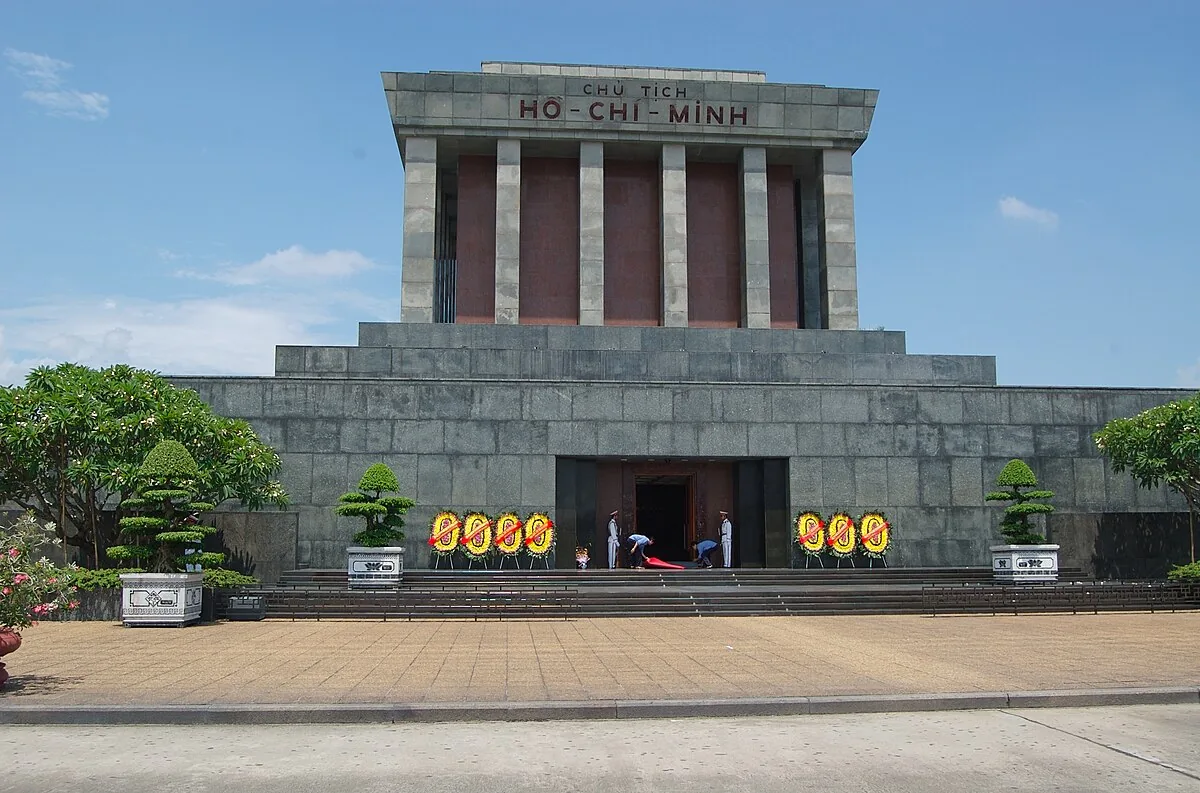
Against his final wishes for a simple cremation, the father of modern Vietnam lies eternally preserved in a 20-meter tall granite fortress of Soviet-inspired design.
About Ho Chi Minh Mausoleum
Built during the height of the Cold War, the mausoleum was a grand project of socialist realism intended to rival the monuments of the Soviet Union. The site itself, Ba Dinh Square, is where Ho Chi Minh read the Declaration of Independence in 1945, making the location a sacred geography of Vietnamese statehood. Over the decades, the square has hosted massive military parades and state funerals, but it remains a public space where Hanoians gather at sunset to exercise and socialize. The building’s grey exterior was designed to look like a lotus flower, though its blocky, imposing form often strikes Western visitors as more fortress-than-flower. It works as a permanent reminder of the power of personality in 20th-century history.
What Ho Chi Minh Mausoleum actually is
A massive, grey granite block rises above the sprawling Ba Dinh Square, serving as the final resting place for the man the Vietnamese affectionately call Uncle Ho. The Ho Chi Minh Mausoleum is a site of intense national reverence, its design inspired by Lenin’s tomb in Moscow but infused with distinct Vietnamese architectural elements like the sloping roofline. Guards in crisp white uniforms stand in frozen vigilance around the perimeter, maintaining a level of discipline that borders on the theatrical. Inside the cool, dim interior, the embalmed body of the revolutionary leader lies in a glass sarcophagus, appearing remarkably peaceful despite the decades of conflict he navigated. For many visitors, a trip here is less about sightseeing and more about a somber pilgrimage to the heart of the nation’s political identity.
Ho Chi Minh famously requested
Ho Chi Minh famously requested in his will to be cremated and his ashes scattered across the three regions of Vietnam as a symbol of national unity. However, the Communist Party decided otherwise, believing that a permanent monument would provide a unifying symbol for the people during the final push for reunification. Construction began in 1973 using materials gathered from across the country, including granite from the central highlands and wood from the northern forests. Soviet experts were brought in to assist with the embalming process, a secret science that remains a point of fascination today. Every year, the mausoleum closes for two months while the body is flown to Russia for expert maintenance, ensuring that the 'Great Leader' remains visually preserved for future generations.
Visiting Ho Chi Minh Mausoleum
The air outside in Ba Dinh Square is often hot and still, smelling of mown grass and the distant sound of flagpole cables clanking in the wind. Once you step into the mausoleum, the temperature drops sharply, and a heavy, absolute silence takes hold. nothing but the synchronized shuffling of feet on the polished stone floors. At once, the intense red glow of the lighting in the viewing chamber, which casts a surreal warmth over the leader’s pale features. The guards maintain a terrifyingly still posture, their eyes never following the moving line of visitors. Walking out into the bright light of the surrounding gardens, There is a sudden release of tension as the rigid protocol of the interior vanishes. The smell of jasmine from the nearby presidential palace gardens provides a gentle, floral bookend to the experience.
The mausoleum dominates the Ba Dinh
The mausoleum dominates the Ba Dinh District, located just north of the Temple of Literature. Travelers usually arrive via taxi or cyclo, though it is a pleasant walk from the West Lake area. Access is strictly controlled, with visitors required to leave bags, cameras, and mobile phones at a secure check-point before joining the long, disciplined queue. The viewing hours are restricted to the morning, typically from 7:30 AM to 10:30 AM, and the facility is usually closed on Mondays and Fridays. It is advisable to dress conservatively, shoulders and knees must be covered, to avoid being denied entry by the watchful guards at the head of the line.
The Experience
A strange, electric tension as you join the two-by-two line that snags through the gardens under the watchful eyes of soldiers. Sound-wise of a single whispered word is enough to earn a sharp look from the guards, emphasizing the sacred nature of the space. The element that hits is how the locals often bow their heads as they pass the glass case, their expressions a mix of curiosity and deep sorrow. People generally are struck by how small the man looks in person, a frail figure who toppled empires. The moment you emerge from the dark, cold tomb into the lush, sunny gardens of his former home is when the humanity of the man starts to balance the legend of the monument.
Why It Matters
The mausoleum is the spiritual and political ground zero of the Socialist Republic of Vietnam. It represents the deification of revolutionary leaders in the 20th century and serves as the ultimate symbol of the nation's independence. Beyond politics, it is a masterpiece of collective effort, built with stones and wood donated by citizens from every province of a then-divided country.
Why Visit
Visit the Ho Chi Minh Mausoleum to witness the sheer power of national icon-making. It is one of the few places left on Earth where you can see the results of the Soviet-era embalming arts in a setting of total state ceremony. You go to feel the pulse of a nation that still looks to its founder for moral and political guidance.
✦ Photo Gallery
4 photos of Ho Chi Minh Mausoleum · click to enlarge
Best Season
🌤 Oct-Nov offers the best conditions, as the mausoleum reopens from its annual maintenance break and the Hanoi autumn brings crisp, dry air for the long outdoor queue.
Quick Facts
Best time to visit
Oct-Nov offers the best conditions, as the mausoleum reopens from its annual maintenance break and the Hanoi autumn brings crisp, dry air for the long outdoor queue.
Getting there
In Hanoi, Vietnam; reach Hanoi first, then continue to the site.
What's nearby
Temple of Literature, Ba Be National Park and Ha Long Bay are also in the area.
Location
Hanoi, Vietnam
Type
attraction
Coordinates
21.0367°, 105.8347°
Insider Tips
- 1
Arrive at the security gate by 7:00 AM to beat the massive tour groups and ensure you aren't still in line when the doors close at 10:30 AM.
- 2
Leave your camera in your hotel or be prepared to hand it over to security; taking photos inside or even in the immediate vicinity is strictly prohibited.
- 3
Wear your most respectful clothing; guards will turn away anyone in shorts, tank tops, or hats, regardless of how long they have waited in line.
- 4
Keep your hands out of your pockets and your arms uncrossed while inside the tomb, as these are seen as signs of disrespect in the presence of the leader.
- 5
Visit the nearby 'House on Stilts' after the mausoleum to see the modest way Ho Chi Minh actually lived, providing a fascinating contrast to the granite tomb.