A North Vietnamese tank crashed through these very gates in 1975, stopping the clock on a 1960s palace that remains barely changed since, down to the maps on the wall.
About Independence Palace
This started as home to the Norodom Palace, the residence of the French Governor-General, before it was leveled to make room for this modernist statement. Architect Ngo Viet Thu, the first Vietnamese person to win the Grand Prix de Rome, intended the palace to be a fusion of Western technique and Eastern soul. During the war, the basement was expanded into a sophisticated command center capable of withstanding heavy shelling, complete with a direct line to the American embassy. When the South Vietnamese government surrendered, the palace was renamed from 'Independence' to 'Reunification' to mark the birth of the modern socialist state. It remains the most important architectural relic of the short-lived Republic of Vietnam.
What Independence Palace actually is
A sprawling white concrete landmark sits at the end of a long, sun-drenched boulevard, its modernist facade appearing like a frozen mid-century dream. Independence Palace, also known as Reunification Palace, is a time capsule of 1960s and 70s aesthetics that was the nerve center of the South Vietnamese government. The building is a masterpiece of tropical modernism, featuring airy corridors, grand reception halls, and a rooftop helipad that still hosts a vintage Huey helicopter. Beneath the polished floors and red-carpeted ballrooms lies a starkly different world: a labyrinthine basement bunker filled with vintage radio equipment and maps. The luxury of power and the cold reality of wartime survival exist in a vertical stack, separated only by a few meters of reinforced concrete.
“A sprawling white concrete landmark sits at the end of a long, sun-drenched boulevard, its modernist facade appearing like a frozen mid-century dream.”
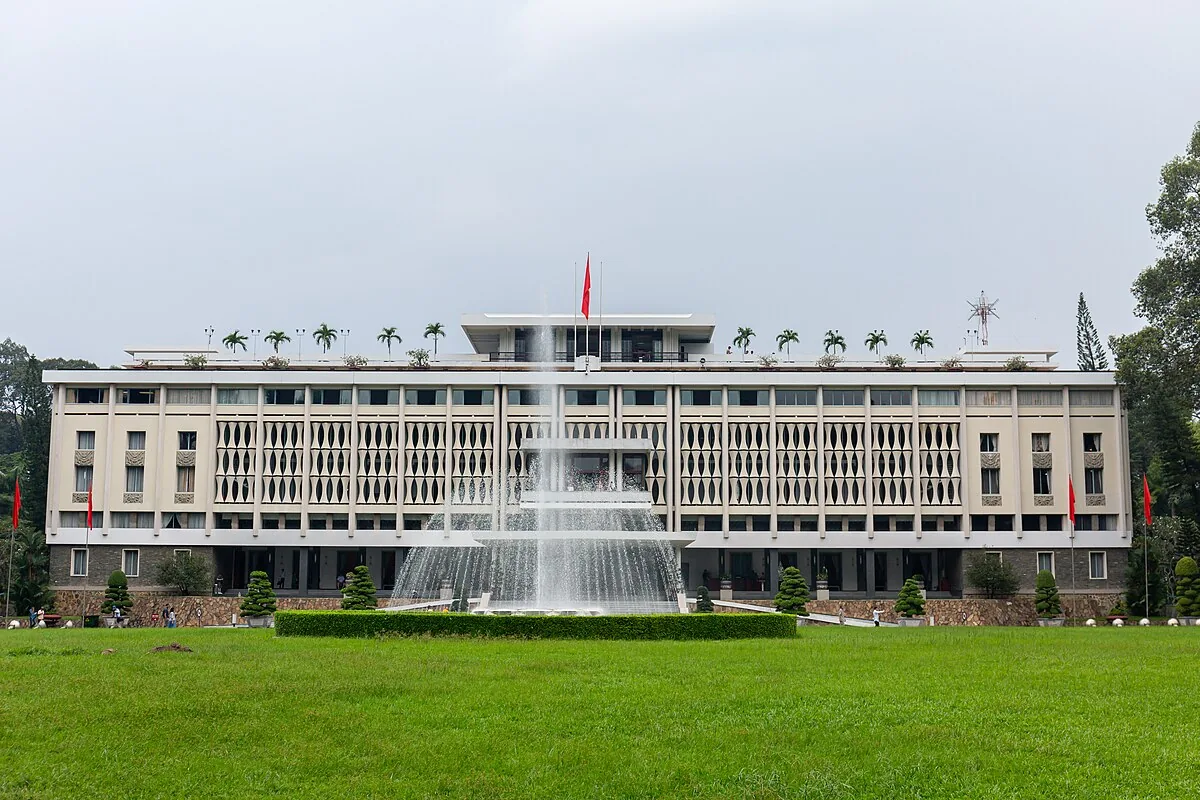
Independence Palace, Vietnam
Ngo Dinh Diem, the first president
Ngo Dinh Diem, the first president of South Vietnam, ordered the construction of the current palace after a 1962 assassination attempt by his own air force destroyed the previous colonial-era building. Architect Ngo Viet Thu won the contract, designing a structure that incorporated traditional Chinese characters into its footprint to symbolize prosperity and freedom. On April 30, 1975, the world watched as a North Vietnamese tank crashed through the palace gates, signaling the end of the Vietnam War and the beginning of reunification. The building was not demolished or converted into offices; instead, it was preserved exactly as it was on that day. Today, it remains a functioning government site for state visits, though most of its rooms serve as a living museum of the defunct South Vietnamese state.
The air inside the grand halls is surprisingly cool, circulated by massive open-air vents and the high, cavernous ceilings. From somewhere comes the rhythmic, hollow echo of footsteps on marble and the distant, muffled hum of city traffic through the massive glass windows. Moving through the President’s private quarters, The smooth grain of the rosewood furniture and the plushness of the original carpets. Straight away, the kitschy, opulent details of the 1970s, the shag rugs, the golden rotary phones, and the circular cinema room that feels pulled straight from a spy film. The light in the basement bunker is fluorescent and pale, casting long shadows over the original military maps that still hang on the walls. Up on the balcony overlooking the lawn, the view of the gates provides a powerful visual link to the famous footage of the 1975 collapse.
The palace occupies a massive green block
The palace occupies a massive green block in central District 1, making it the geographical anchor of Ho Chi Minh City’s tourist center. Most who visit arrive on foot from the nearby Ben Thanh Market or the War Remnants Museum. The main entrance is on Nam Ky Khoi Nghia street, where a small ticket booth provides access to the grounds. While the building is open daily, it occasionally closes without warning for official state receptions, so it is wise to check the gates for notices before planning your morning around a visit.
“The palace occupies a massive green block in central District 1, making it the geographical anchor of Ho Chi Minh City’s tourist center.”
The Experience
A sense of surreal nostalgia as you wander through the 'Gambling Room' and the private cinema, which look like they are waiting for a party that ended fifty years ago. The clatter of the wind whistling through the modernist concrete slats on the facade is the only thing that breaks the stillness of the upper floors. What registers is how the basement feels like a submarine, with its narrow steel doors and air-filtration systems still intact. Most visitors focus on the grand reception rooms, but the real atmosphere is in the kitchen, where giant 1960s appliances sit ready for a state banquet that will never happen. The moment you step onto the roof and see the red 'X' where the helicopter once landed, the drama of the final evacuation feels visceral.
Why It Matters
The palace is a world-class example of 1960s modernist architecture and a pivotal site in 20th-century geopolitical history. It serves as the physical end-point of the Vietnam War and a symbol of the nation's transition from a divided colony to a unified power. Culturally, it is a rare preserved interior that showcases the unique 'Saigon Modern' aesthetic of the mid-century era.
Why Visit
Visit the Independence Palace because it is the closest thing to time travel you will find in Southeast Asia. It offers a rare look at the 'other side' of the war’s history in a setting of strange, faded glamour. You go for the historical significance, but you stay for the incredible design and the eerie, preserved atmosphere of a fallen government.
Insider Tips
- 1
Hire one of the official guides at the entrance; their stories about the specific functions of the basement rooms add a layer of human drama that the placards miss.
- 2
Head straight to the basement bunker if you see large tour groups in the main halls, as the narrow corridors can become claustrophobic when crowded.
- 3
Visit the rooftop cafe for a view over the tree-lined boulevards of District 1, which offers some of the best perspectives on the city's French-planned layout.
- 4
Check the schedule for the free documentary film shown in the palace cinema; it provides a fascinating, if biased, account of the building's role in the war.