Generations of mountain farmers used hand-forged tools to carve these 12,000 hectares of vertical slopes into a functional, liquid staircase of rice and water.
About Muong Hoa Valley
The valley’s terraces were built bit by bit over hundreds of years, a result of the patience of the Hmong and Dao people who settled here after fleeing conflict in southern China. Each terrace is a feat of hydrological planning, designed to trap just enough water to feed the rice while allowing the excess to spill safely to the level below. In the 1920s, French colonialists established a hill station in nearby Sapa, but the valley itself remained a remote world of tribal customs until the late 20th century. The discovery of the ancient petroglyphs in 1924 by a French-Russian researcher added a layer of historical mystery, proving the valley was a crossroads for lost civilizations. Today, it is recognized as a national heritage site, protecting the world's most impressive examples of high-altitude wet-rice cultivation.
Muong Hoa Valley in Vietnam
Terraced rice paddies cascade down the steep slopes of the Hoang Lien Son mountains like a giant staircase carved from emerald and gold. Muong Hoa Valley is the vibrant, agricultural lungs of the Sapa region, where the Muong Hoa River carves a silver path through the basin floor. Small hamlets belonging to the Hmong, Zay, and Red Dao ethnic groups cling to the ridges, their traditional wooden houses topped with grey stone or thatch. The landscape changes its character entirely with the cycle of the seasons, shifting from the mirror-like flooded pools of early spring to the heavy, swaying stalks of grain in late autumn. While Sapa town grows increasingly vertical with hotels, the valley retains its rural rhythm, governed by the movement of water and the manual labor of mountain farming.
“Terraced rice paddies cascade down the steep slopes of the Hoang Lien Son mountains like a giant staircase carved from emerald and gold.”
Muong Hoa Valley, Vietnam
Centuries of indigenous engineering created this
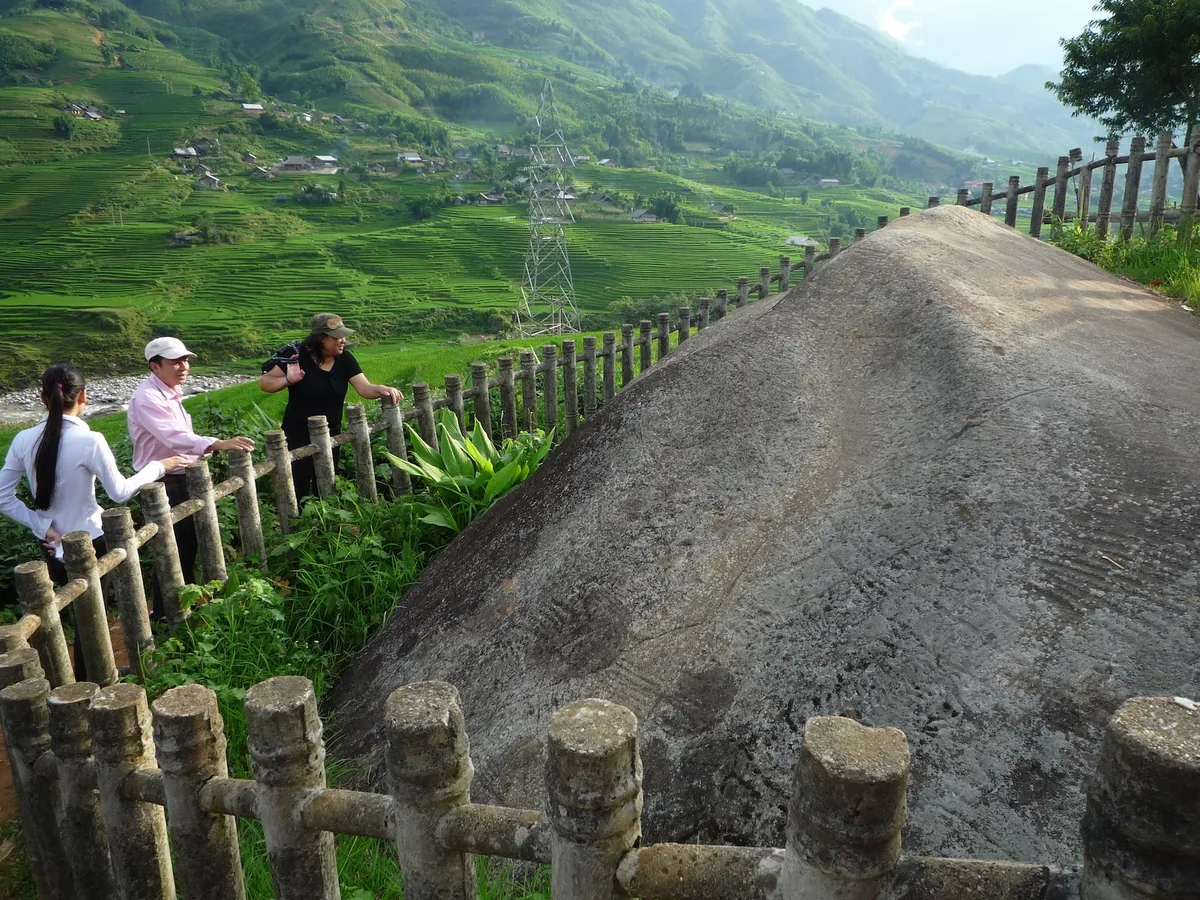
Centuries of indigenous engineering created this landscape, as generations of farmers used nothing but hand tools to level the mountain slopes and divert stream water through complex bamboo irrigation systems. The valley also holds a mysterious prehistoric legacy in its 'Ancient Rock Field,' a collection of nearly two hundred boulders carved with strange petroglyphs that have baffled archaeologists for decades. These carvings, depicting maps, figures, and abstract patterns, suggest that Muong Hoa has been a site of human significance long before the current ethnic groups migrated to these heights. Despite the rise of tourism, the community still operates on a deep-seated respect for the land, maintaining a delicate balance between welcoming trekkers and preserving the ancestral soil that provides their primary sustenance.
The air is sharp and carries the scent of woodsmoke, damp earth, and the sweet, grassy aroma of ripening rice. From somewhere comes the rhythmic clinking of silver jewelry worn by Hmong women and the distant, melodic rush of the river far below the trail. Down the muddy paths, The spongy texture of the mountain soil and the occasional cool spray from a hidden waterfall. The opening note is the vibrant indigo dyes staining the hands of local weavers, a permanent mark of their craft. The light at mid-afternoon creates a dramatic play of shadows across the terraces, highlighting the sharp edges of each individual field. At a viewpoint near Hau Thao village, the sheer verticality of the landscape makes the tiny figures of buffalo in the fields look like ants moving across a green velvet fabric. Most explorers start their journey in Sapa, following the winding road that descends from the town into the valley floor. While taxis and motorbikes can reach the main villages of Lao Chai and Ta Van, the best way to experience the valley is via a guided trek through the rice paddies. These trails are often narrow and can become extremely slippery after the frequent mountain rains. For those arriving from Hanoi, the overnight sleeper train to Lao Cai remains the most classic approach, followed by a one-hour bus climb to Sapa. Recently, a cable car to Fansipan peak has provided an aerial perspective of the valley, though nothing replaces the intimacy of walking through the village gates on foot.
The Experience
Something of a sense of profound scale as you look down from a ridge and realize that every single line in the landscape was shaped by a human hand. Sound-wise of water trickling through bamboo pipes provides a constant, soothing soundtrack to your hike. It becomes clear how the color of the valley shifts from a brilliant, neon green in June to a deep, heavy gold by September. People generally focus on the view, but the real heart of the experience is sharing a glass of corn wine in a wooden home while the mountain mist rolls in through the doorway. The moment the clouds part to reveal the peak of Fansipan towering over the terraces is when the valley’s true majesty is revealed.
Why It Matters
Muong Hoa is the cultural heartland of Vietnam's northern highlands. It represents the height of indigenous agricultural technology and serves as a living museum for the traditions of the Hmong and Dao people. Historically, it is one of the few places where prehistoric carvings and active, centuries-old farming techniques exist in the same physical space.
Why Visit
Visit Muong Hoa Valley because it offers a visual harmony that feels almost impossible in its perfection. It is a place where you can witness the tangible results of human persistence over hundreds of years. You go to walk through a landscape that is both a work of art and a vital source of life.
Insider Tips
- 1
Avoid the main road and hire a local Hmong guide to take you through the 'back' trails that weave through the upper terraces for better views and fewer crowds.
- 2
Wear proper hiking boots with deep lugs; the local clay becomes exceptionally slick and 'treacherous' even after a light mist.
- 3
Stay overnight in a Ta Van homestay to experience the valley in the early morning when the mist is thickest and the tourists have yet to arrive from Sapa.
- 4
Look for the 'Ancient Rock Field' between the villages of Lao Chai and Ta Van; the carvings are subtle and easily missed without a guide pointing them out.
- 5
Pack a light waterproof jacket even in the dry season, as the valley creates its own microclimate and sudden downpours are common.