“This museum houses the ghosts of a kingdom that disappeared from the maps centuries ago, told through sandstone gods that seem to breathe in the natural light.”
About Museum of Cham Sculpture
The collection was born from the salvage missions of French colonial scholars who hauled these multi-ton blocks through the jungle on ox carts. Many of the pieces were found in pieces, having been smashed during the many wars between the Cham, the Vietnamese, and the Khmer. The museum building itself has survived the occupation of multiple armies, each of which respected the sanctity of the stone enough to leave the collection intact. In the late 20th century, the museum became a center for international collaboration, with experts from the Louvre helping to restore the most delicate terra-cotta friezes. It stands as the definitive visual library for an entire ethnic identity.
What Museum of Cham Sculpture actually is
A colonial-era building with pale yellow walls and open-air galleries sits at a busy intersection in Da Nang, housing the world's most significant collection of art from a lost empire. The Museum of Cham Sculpture is a temple to the craftsmanship of the Champa Kingdom, featuring hundreds of sandstone and terra-cotta works rescued from the jungle-choked ruins of central Vietnam. The architecture itself is a fusion of French and Cham styles, designed to allow natural light and sea breezes to circulate through the halls. Inside, the fierce expressions of guardian lions and the serene smiles of Hindu deities provide a silent narrative of a civilization that once ruled the coast. It is a place of intense stillness in the middle of a booming modern city, where the weight of ancient stone provides a grounding counterpoint to the rush of the surrounding streets.
A colonial-era building with pale yellow walls and open-air galleries sits at a busy intersection in Da Nang, housing the world's most significant collection of art from a lost empire.
French archaeologists of the École Française
French archaeologists of the École Française d’Extrême-Orient began collecting these sculptures in the late 19th century, recognizing that the ruins of My Son and Dong Duong were being systematically looted or reclaimed by the forest. The museum was officially founded in 1915 and opened its doors in 1919, designed by French architects who drew inspiration from the very temples where the art originated. Throughout the conflicts of the 20th century, the collection was moved and hidden multiple times to protect it from theft and destruction. It remains the only museum in the world specifically dedicated to Cham art, serving as a vital repository for a culture whose written records were largely lost to time. Recent expansions have modernized the facility, but the core of the museum retains the quiet, airy charm of its early 20th-century roots.
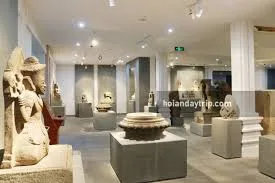
The air is cool and moves through the arched windows, carrying a faint scent of salt from the nearby Han River. From somewhere comes the distant, muffled thrum of city traffic, which sounds like the white noise of a different century. Passing through the 'My Son' gallery, the smooth, cool surface of the ancient sandstone and the heavy presence of the massive altars. The incredible detail in the jewelry carved into the stone, delicate necklaces and crowns that look as if they were made of silk rather than rock. The light is soft and natural, casting long, dramatic shadows that bring the three-dimensional figures of Shiva and Ganesha to life. Standing before the massive Tra Kieu pedestal, the sheer complexity of the storytelling in the stone is enough to keep you mesmerized for an hour.
Location and access
The museum is located in the middle of Da Nang, at the intersection of Bach Dang and Trung Nu Vuong streets, overlooking the Dragon Bridge. It is an easy walk from the main riverside promenade and is a standard stop for any city tour. Travelers usually visit the museum as a morning activity before heading to the Marble Mountains or Hoi An. Because it is an open-air facility, visiting in the early morning is highly recommended to avoid the midday heat and to see the sculptures in the most flattering natural light.
The museum is located in the middle of Da Nang, at the intersection of Bach Dang and Trung Nu Vuong streets, overlooking the Dragon Bridge.
The Experience
The sense of intimate connection with the past as you realize there are no glass barriers between you and the 1,000-year-old statues. You hear the ceiling fans provides a steady, low-frequency hum that emphasizes the silence of the stone. It becomes clear how the expressions on the faces of the dancers change as you walk around them, a trick of the ancient carvers who understood the movement of light. Most visitors spend their time in the main hall, but the real gems are the small, terra-cotta fragments in the side galleries that show the domestic life of the Cham. The moment you look into the eyes of a guardian lion and see the playful detail in its stone mane is when the Cham people stop being a history lesson and become human.
Why It Matters
The Museum of Cham Sculpture is the most important cultural institution in Central Vietnam. It holds the largest collection of Cham art in the world and is essential for understanding the Hindu and Buddhist influences that shaped the region before the arrival of the Vietnamese. It is a monument to the endurance of artistic beauty over the transience of political power.
Why Visit
Visit the Cham Museum because it provides the necessary 'key' to understanding the ruins you will see at My Son. It offers a chance to see the detail of Cham art up close in a tranquil, beautiful setting. You go for the history, but you stay for the incredible artistic mastery that rivals the best of the Italian Renaissance.
✦ Insider Tips
- 1
Hire a local guide at the entrance; the mythological stories behind the sculptures are dense and the museum’s placards can be a bit brief.
- 2
Start in the Tra Kieu gallery to see the museum’s masterpieces before your eyes get 'statue fatigue' in the later rooms.
- 3
Look for the 'Uroja' motifs, they represent breasts and are a unique symbol of fertility and the maternal line in Cham culture.
- 4
Check the museum's small library if you are a history buff; they have rare publications on Cham archaeology that are hard to find elsewhere.