“These 1,000-year-old temples were built with a secret brick-binding technique so advanced that modern scientists still can't fully replicate the invisible mortar.”
About My Son Sanctuary
For a thousand years, My Son was the longest-inhabited archaeological site in Indochina, serving as the religious capital for a succession of Cham kings. Each monarch built at least one new temple to demonstrate their devotion and divine right to rule. The site was abandoned in the 15th century and largely forgotten by the outside world until M. C. Paris, a French soldier and scholar, stumbled upon it during the colonial era. The tragic irony of My Son is that it survived a millennium of ethnic wars only to be nearly destroyed by modern aerial warfare. It was inscribed as a UNESCO World Heritage site in 1999, sparking a global effort to preserve the 'forgotten' history of the Champa people.
My Son Sanctuary in short
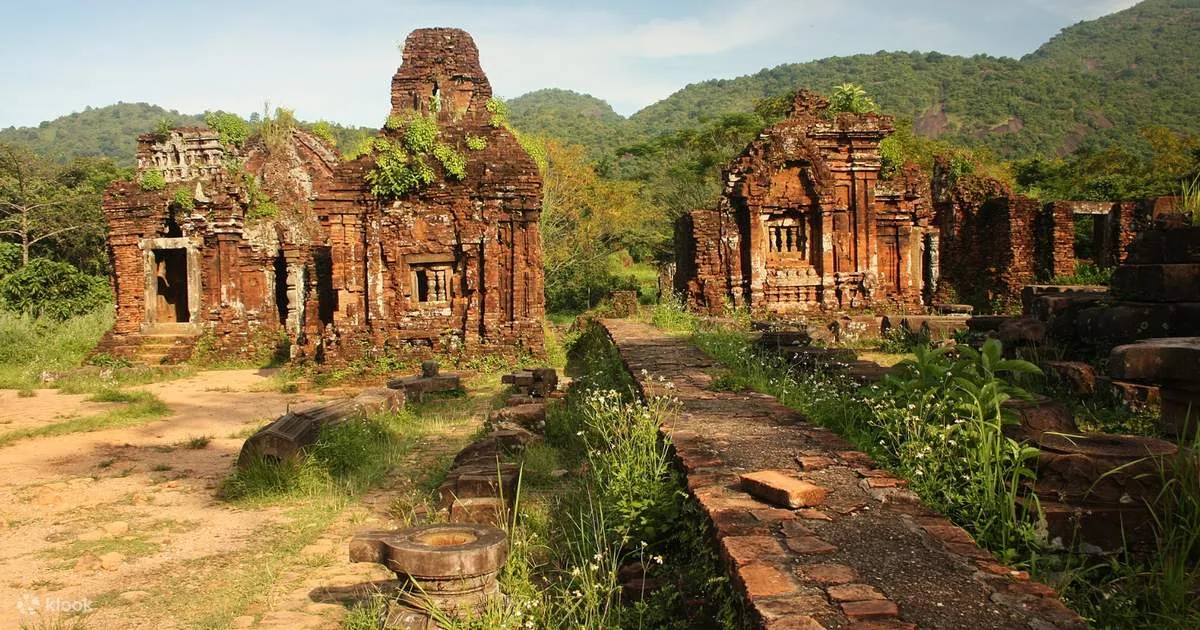
Red brick towers, weathered by a millennium of tropical rain and the scars of modern war, huddle in a lush valley beneath the Cat’s Tooth Mountain. My Son Sanctuary is the spiritual heart of the extinct Champa Kingdom, a collection of Hindu temples dedicated to Shiva that was a royal burial ground and religious center. The architecture is a mystery of ancient engineering, where bricks were joined together so tightly that the mortar remains invisible to the naked eye. While the site was once a sprawling complex of over seventy structures, today only a fraction remain standing, surrounded by the craters of American B-52 bombs. The ruins are draped in jungle vines and moss, creating an atmosphere of quiet, tragic beauty like a Vietnamese version of Angkor Wat, though on a more intimate and haunting scale.
Red brick towers, weathered by a millennium of tropical rain and the scars of modern war, huddle in a lush valley beneath the Cat’s Tooth Mountain.
History
The Cham people, a seafaring civilization of Malayo-Polynesian origin, ruled central Vietnam from the 4th to the 14th century. They built My Son as their most sacred site, a place where kings were cremated and their spirits were believed to join the gods. The kingdom eventually declined as the Vietnamese moved south, and the jungle swallowed the temples for nearly four hundred years until French explorers rediscovered them in 1898. The 20th century was brutal to My Son; because the Viet Cong used the ruins as a base, the area was heavily carpet-bombed in 1969. In a single week, many of the site's most impressive towers were reduced to rubble. Since then, international teams from Italy and Poland have worked to stabilize the remaining bricks, using traditional techniques to ensure the kingdom’s legacy doesn't vanish into the forest.
The air smells of wet ferns, wild jasmine, and the earthy musk of ancient brick. From somewhere comes the rhythmic, high-pitched buzz of cicadas and the occasional haunting notes of a Cham dance performance echoing through the valley. The crossing of the ruins, the rough, sandy texture of the sun-warmed bricks and the humidity that clings to the jungle floor. First, the incredible detail in the sandstone carvings, curvy dancers, multi-armed deities, and fierce guardian animals, their features softened by time but still remarkably expressive. The light at sunrise is spectacular, filtering through the mountain peaks and hitting the red brickwork until it glows like an ember. Standing near the massive bomb craters that sit adjacent to the 10th-century temples, the contrast between ancient creation and modern destruction is almost physically painful.
My Son is located forty kilometers
My Son is located forty kilometers west of Hoi An, making it a popular half-day trip for those staying on the coast. People typically arrive via air-conditioned shuttle or by renting a motorbike for the scenic ride through the rural villages and rice paddies. Arriving at the site before 8:00 AM is the only way to beat the heat and the large tour groups that arrive by mid-morning. Once at the entrance, an electric shuttle takes you to the start of the walking paths, which wind through the various groups of temples in a well-marked loop.
My Son is located forty kilometers west of Hoi An, making it a popular half-day trip for those staying on the coast.
The Experience
You feel a shiver of history as you walk through a doorway carved in the 9th century and realize you are standing in a royal tomb. The clatter of your footsteps on the grass is the only noise in the quiet morning, before the tourist buses bring the world back to the valley. What hits is how the jungle is slowly trying to reclaim the stone, with roots weaving through the brickwork like frozen lightning. The majority just take a few photos and move on, but the real power is found in sitting quietly among the broken pedestals and imagining the smoke of the cremation fires that once filled the air. The moment you see a headless statue of Shiva standing in a bomb crater is when the fragility of culture becomes undeniably clear.
Why It Matters
My Son is the most important site of the Champa civilization in Vietnam. It represents a unique architectural style that fused Indian Hinduism with local Southeast Asian artistry. Historically, it is the primary source of our understanding of the Cham people, whose influence once dominated the maritime trade routes between China and India.
Why Visit
Visit My Son because it offers a raw and unpolished look at the layers of history that make up modern Vietnam. It is less crowded and more atmospheric than many other Asian ruins, providing a space for genuine reflection. You go to see the temples, but you stay for the haunting story of a kingdom that the forest almost won back.
✦ Insider Tips
- 1
Hire a private guide at the entrance; the history of the Champa people is complex and the meaning of the carvings is easily lost without an expert explanation.
- 2
Stay for the traditional Cham dance performance held at the onsite theater; the music and costumes provide a vital living context to the silent ruins.
- 3
Look for the 'Group B' temples, which are the best-preserved and contain the most intricate sandstone carvings of the gods.
- 4
Carry plenty of water and insect repellent, as the valley traps the heat and the mosquitoes can be aggressive in the shaded jungle paths.
- 5
Check the status of the ongoing restoration projects; some temple groups may be closed to the public for safety while teams work on the masonry.