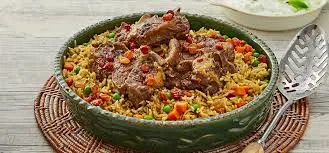
"The hollow black limes that give this dish its defining sour depth were once traded across the Indian Ocean as one of the Gulf's most valuable spice exports, now they transform basmati rice into the UAE's most important meal."
About Al Machboos
The UAE's national dish: long-grain basmati steeped in a broth of dried limes, turmeric, coriander, rose water and loomi before being layered with slow-braised lamb or chicken; the dried black lime (loomi) gives a haunting, tangy depth no other Gulf dish achieves.
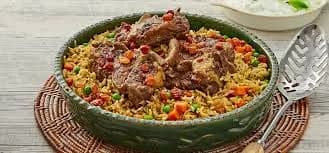
Al Machboos, a staple of United Arab Emirates's cuisine
Overview
Al Machboos is the national dish of the UAE and the most complex rice preparation in Gulf cuisine: a layered construction of long-grain basmati, slow-braised meat, and a broth so perfumed with dried limes, saffron and rose water that the steam alone carries an entire spice market. Unlike the simpler biryanis that cross its path conceptually, machboos is cooked in two distinct stages: the meat braised first in a spiced broth until falling tender, then the rice cooked in that broth until each grain is separate, fragrant and stained a deep amber from the turmeric and tomato. The defining element that separates machboos from every other Gulf rice dish is the loomi: dried black lime, a fermented citrus preserved to a dark, hollow husk. When added whole to the braising liquid, it releases a haunting sourness that no fresh citrus can replicate, a tangy depth that runs beneath the sweetness of the saffron and the warmth of the cardamom. The smell of loomi in a hot broth is the smell of an Emirati kitchen.
The Story Behind It
Machboos has been the table centerpiece of Emirati hospitality for centuries, its spice profile a direct record of the trade routes that passed through the Gulf: cinnamon from Ceylon, cardamom from Kerala, dried limes from Oman and Persia, saffron from Iran. Historically, the most prestigious version was made with fresh hamour (grouper) from the Gulf waters, a fish version that predates the lamb and chicken adaptations by generations. Today both exist in parallel, the fish version remaining the preference in coastal households and the lamb version more common inland.
What It Tastes Like
The rice arrives mounded on a large communal platter, the meat arranged on top, with a bowl of yoghurt and a tomato and onion salad alongside. The first spoonful carries every layer of the broth simultaneously, the sourness of dried lime cutting through the fat of the braised meat, the floral top note of rose water dissolving into the warmth of cinnamon. The texture of properly cooked machboos rice is non-negotiable: each grain must be individual, never sticky, absorbing the broth without losing its structure.
Where to Find It
The best machboos in the UAE is eaten in private homes, but for visitors, the Al Fanar Restaurant chain and Bu Qtair in Dubai's Jumeirah serve versions worth travelling for. In Abu Dhabi, the Mezlai restaurant at Emirates Palace offers a refined interpretation. The Friday lunch buffet at many traditional Emirati restaurants is the most reliable opportunity. Machboos is the anchor of every serious Emirati spread.
What to Expect
Machboos arrives as a mountain of amber-stained rice on a shared platter, fragrant before it reaches the table. Locals eat it with the right hand, gathering rice and meat together in a single compressed mouthful, which changes the flavour completely, concentrating the spices and revealing the textural contrast between the firm grain and the pull-apart meat. The yoghurt served alongside is not optional: its cold acidity resets the palate between mouthfuls and allows the dish's complexity to keep revealing itself.
Why Try It
Al Machboos is the answer to the question of what Emirati food actually tastes like beneath the surface of the country's global restaurant scene. It is a dish that encodes seven centuries of maritime trade in every spoonful: the flavour of a civilization that connected India, East Africa, Persia and the Arab world through a single busy waterway. No other dish tells the story of the UAE with equal precision.
✦ Photo Gallery
Insider Tips
Order the fish version (machboos samak) if visiting a coastal restaurant, the hamour grouper version is the historically original preparation and the most complex.
Eat with the right hand in the traditional way, or at least use bread to gather the rice, since a fork loses the textural experience the dish is built around.
The loomi (dried lime) in the bowl is not meant to be eaten whole. Having given its flavour to the broth, it can be pressed gently with a spoon to release any remaining juice.
Friday lunch is the best time to eat machboos at Emirati restaurants. It is the national dish for a reason and reaches its peak as a communal midday meal.
Leftovers are eaten differently: cold machboos rice the next morning, mixed with yoghurt and eaten for breakfast, is an Emirati tradition worth experiencing.