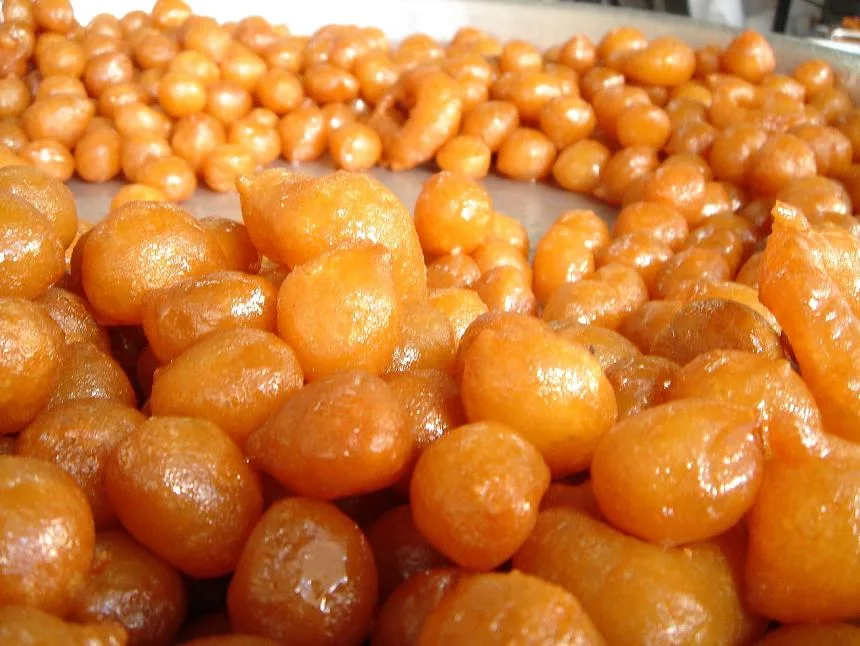
"Fried to order in a single hot cauldron and drizzled with date syrup pressed from the same palms that have sustained the Emirati desert for three thousand years, Luqaimat are the UAE's most immediate and most honest expression of hospitality."
About Luqaimat
Crispy fried dumplings no bigger than a walnut, drizzled tableside with dark date syrup and dusted with sesame; sold from street stalls across the UAE during Ramadan nights; the contrast of the shatteringly crisp shell and cloud-soft interior makes them impossible to eat just one.
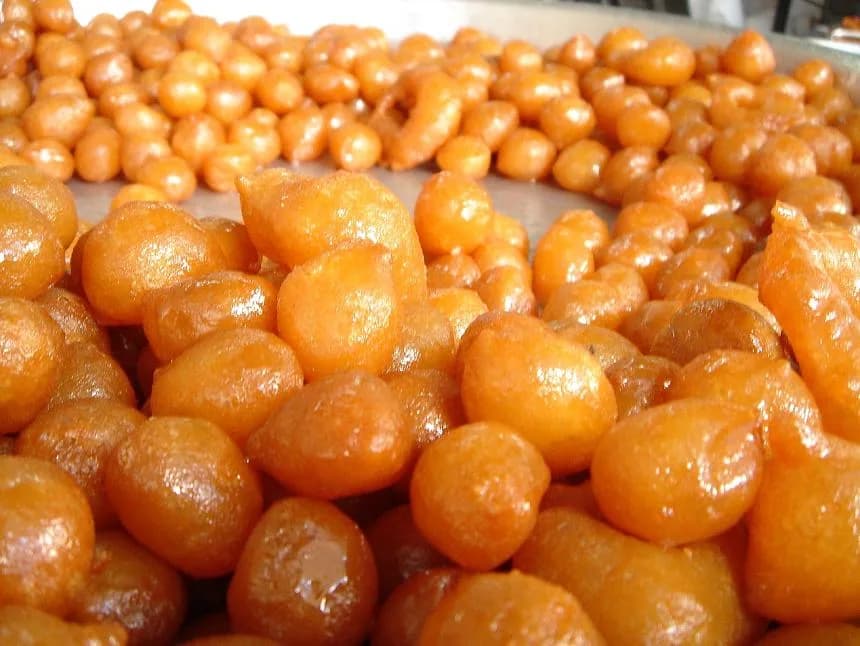
Luqaimat, a staple of United Arab Emirates's cuisine
Overview
Luqaimat are the UAE's answer to a question asked by every civilization that has ever had excess flour, oil and a sweet tooth: what is the fastest route from those ingredients to something that makes people smile? The answer, in the Emirati tradition, is a walnut-sized ball of yeasted dough dropped into hot oil and fried until the exterior achieves a perfect lacquered golden shell, then drizzled immediately with dark date syrup (dibs tamr) and dusted with sesame seeds. The result is consumed before it cools. The name comes from the Arabic root meaning 'bite-sized morsels', and the proportion is everything, too large and the interior becomes doughy before the exterior crisps; too small and the ratio of crust to molten interior collapses. Generations of Emirati grandmothers have calibrated this to muscle memory, dropping each ball with a wet spoon that releases it cleanly into the oil.
The Story Behind It
Luqaimat appear in medieval Arab cookbooks and across the entire Arab world under varying names: awwama in Lebanon, lokma in Turkey, gulab jamun's distant ancestor in the subcontinent. In the UAE they have become inseparable from two moments: Ramadan nights, when street stalls sell nothing else, and the arrival of guests, when a plate of freshly fried luqaimat is the immediate hospitality offering before coffee or tea. The date syrup connection is particularly Emirati. Dates are the country's most sacred food product and their syrup is used here rather than the sugar syrups of neighbouring countries.
What It Tastes Like
The crust shatters audibly on the first bite: a thin, crisp shell that gives way immediately to a cloud-soft, slightly sour interior from the yeast fermentation. The date syrup is not a background note; it is thick, deeply caramelised and complex, carrying the concentrated sweetness of the desert date alongside a mineral darkness that simple sugar syrup never achieves. The sesame seeds add a nutty punctuation that lingers after the sweetness has faded.
Where to Find It
Luqaimat are most reliably found at Ramadan street stalls, which operate across Dubai and Abu Dhabi from sunset to midnight throughout the holy month. The stands outside the Dubai Frame and along the Abu Dhabi Corniche are well-established. Year-round, the Al Fanar Restaurant in Festival City serves a version with proper date syrup, and many traditional Emirati breakfast spots offer them in the mornings. They are not a restaurant dessert by nature. They are street food, and they are best eaten from a paper cup on a hot night.
What to Expect
The stall operates with a specific rhythm: the batter in a bowl to the left, the spoon dipped and released in a single motion, a dozen balls dropping into the oil in quick succession, the fryer monitoring with the focus of someone who has made this ten thousand times. The aroma of hot oil and yeast mixes with date syrup in a combination that is specifically Arabian in a way that resists exact description. Luqaimat are eaten scalding hot, and there is no polite way to consume them: fingers, a wooden skewer or a paper fork are used, eaten immediately from a cup.
Why Try It
Luqaimat during a Dubai Ramadan night is one of the most sensory-rich food experiences the UAE offers to a visitor: the street stalls, the warm evening air, the communal act of eating fried dough drizzled with date syrup at 10 p.m. surrounded by a city breaking fast together. It is a food that only works in its correct context, and the correct context is worth travelling for.
✦ Photo Gallery
Insider Tips
Visit during Ramadan, luqaimat street stalls only reach their full quality and atmosphere during the holy month, when demand is high enough to ensure the oil is always fresh and the batter always newly made.
Eat them within two minutes of receiving them. They do not improve with age, the crust softens rapidly as the date syrup soaks in.
Ask for extra date syrup on the side. The standard drizzle is conservative; the ratio improves considerably with more.
The best stands are identified by their queue, not their signage. A line of local Emirati families is a more reliable quality signal than any review.
Order them alongside a cup of karak chai (spiced milk tea), the sweetness of luqaimat and the spiced warmth of the tea is the classic combination.