“Nearly two thousand free white bicycles wait at the gates of a private forest, inviting you to ride toward a hidden bunker filled with millions of dollars of Van Gogh masterpieces.”
About Hoge Veluwe National Park
The estate was once a collection of disparate farms and timber plantations until the Kröller-Müllers fenced it off to create a private hunting preserve. They introduced exotic species like the Mediterranean mouflon sheep, which still roam the park today to keep the grass and heather from overgrowing. During the mid-20th century, the park became a battleground for architectural philosophies, moving from the traditionalism of the hunting lodge to the radical modernism of the museum pavilion. This tension between the romantic past and the functional future is what gives the park its unique, slightly surreal character. It survived the occupation of World War II with its art collection largely intact, hidden in a purpose-built bunker buried deep within the sand dunes.
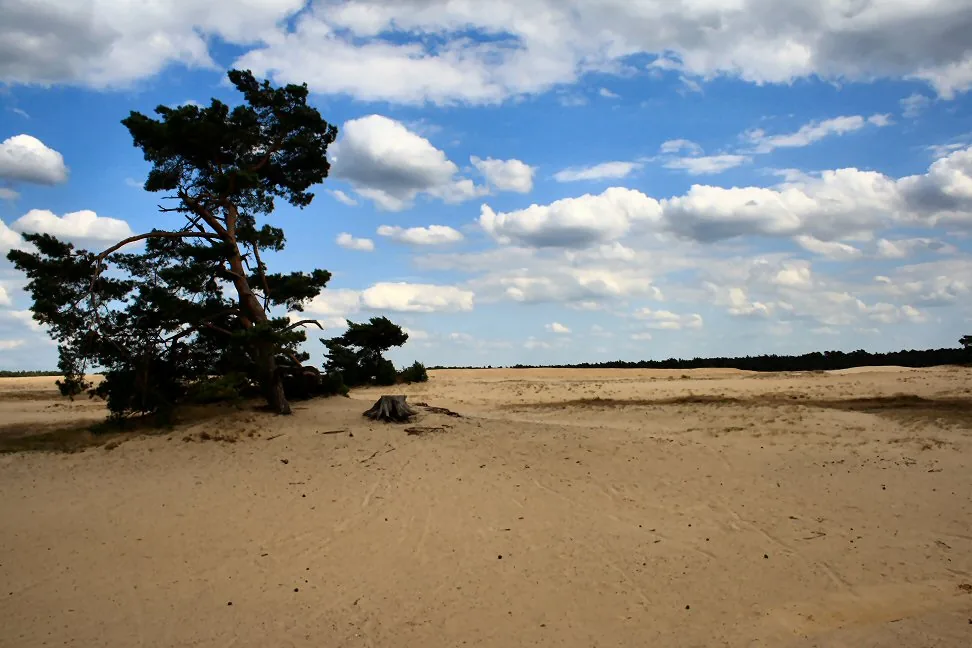
White bicycles stand in silent rows at the park entrances, ready to carry you across a landscape that shifts from dense, mossy woodlands to shifting sand dunes that feel more like the Sahara than the Gelderland province. Hoge Veluwe National Park is a private masterpiece of land art where wildlife and world-class modernism coexist in a delicate, north-European balance. This space tastes of pine needles and heather, carrying a cool clarity that you rarely find in the busy Randstad cities. You pedal along smooth, asphalt paths. Notice how the canopy opens up to reveal vast, golden plains where red deer and mouflon sheep graze in the distance. The audio element is a meditative quiet, dominated by the rhythmic hum of bicycle tires on pavement and the occasional, sharp cry of a black woodpecker. Hidden in the forested heart of this 5,400-hectare estate lies the Kröller-Müller Museum, a sanctuary of Van Goghs and glass-walled galleries that bring the outside in.
Hoge Veluwe National Park is a private masterpiece of land art where wildlife and world-class modernism coexist in a delicate, north-European balance.
Anton and Helene Kröller-Müller purchased this
Anton and Helene Kröller-Müller purchased this vast tract of land between 1909 and 1923, fueled by a singular, obsessive vision to merge fine art with raw nature. Anton was a shipping magnate who used the estate as a private hunting ground, while Helene was one of the first European collectors to recognize the genius of Vincent van Gogh. Their dream was to create a 'museum-home' where their staggering collection, the second largest of Van Goghs in the world, could be viewed in the context of the wild landscape. Financial crises almost halted the project, leading the couple to donate the land and the collection to the Dutch state on the condition that it remain a unified entity. Today, it remains the only national park in the Netherlands where you have to pay an entrance fee, maintaining the high-culture, private-estate atmosphere that the Kröller-Müllers originally intended.
Pedaling through the De Pollen sand drifts, you
Pedaling through the De Pollen sand drifts, The physical transition of the geography as the wheels struggle slightly against the fine, wind-blown silt. The first thing you register is the way the light changes at the edge of the sculpture garden, where massive works by Henry Moore and Jean Dubuffet stand among the pines like strange, silent inhabitants. Sound-wise of your own breathing becomes the primary clock in this car-free zone, a slow rhythm that matches the pace of the wind in the birch trees. Something of the temperature drop entering the museum’s cool, limestone halls, where the vibrant yellows and blues of Van Gogh’s canvases seem to hum against the minimalist walls. What you catch first is the small, deliberate details of the Jachthuis Sint Hubertus, the family’s former hunting lodge, designed to resemble a set of deer antlers from above. The most vivid moment is finding a solitary bench by the heather fields at twilight, watching the sky turn a pale lavender as the first red deer emerge from the tree line.
The park lies between Ede,
The park lies between Ede, Apeldoorn, and Arnhem, making it a manageable day trip from Amsterdam or Utrecht. Trains to Ede-Wageningen connect to local buses that drop you at the Otterlo entrance, the most popular gateway for visitors. Once inside, the famous 'White Bikes' are free to use and scattered throughout the three main entrances. Driving is possible, but a separate car fee applies, and the best parts of the interior are only accessible by bike or on foot. Arriving early is essential to secure a bicycle during the peak season and to experience the sculptures before the afternoon light becomes too harsh for photography.
The park lies between Ede, Apeldoorn, and Arnhem, making it a manageable day trip from Amsterdam or Utrecht.
The Experience
The energy at Hoge Veluwe is one of curated wildness. What registers is the smell of dry earth and resin, a scent that intensifies as the afternoon sun warms the forest floor. The mass of the freedom of the white bikes, no locks, no gears, just a simple back-pedal brake that forces you to slow down and observe. The light is exceptionally soft in the pine groves but turns into a brilliant, unshielded glare on the open plains of the Houtkamp. The way the museum’s architecture disappears into the trees, using glass and steel to frame the forest as if it were a painting itself. The most striking detail is the mouflon, animals that look entirely out of place in northern Europe, yet have become the park's living icons. It is a place that feels like an intentional escape from the 21st century.
Why It Matters
Hoge Veluwe is a singular experiment in private philanthropy and landscape preservation. It represents the height of early 20th-century Dutch cultural ambition, proving that industrial wealth could be transformed into a public legacy of art and ecology. Historically, it is significant as the home of the Kröller-Müller Museum, a temple of modernism that changed how the world perceives the relationship between art and the environment.
Why Visit
The draw: you want to see a landscape that feels like a dream. While other parks are for hiking, Hoge Veluwe is for aesthetic contemplation. You come here to ride a bike with no destination, to find a Henry Moore sculpture in the middle of a forest, and to see Van Gogh’s colors in the very light that inspired him. It is the only place on earth where the museum is as wild as the woods.
✦ Insider Tips
- 1
Use the smaller Hoenderloo entrance if you want to reach the Kröller-Müller Museum faster; it is less crowded than the Otterlo gate.
- 2
Check the height of the bike seats before you set off; the white bikes come in one size but the seat pins can be adjusted by hand.
- 3
The Jachthuis Sint Hubertus requires a separate guided tour ticket; book this at the entrance as they sell out by midday.
- 4
Bring your own water bottle; there are several natural spring taps near the museum where you can refill for free.
- 5
Look for the 'underground' Museonder, a museum dedicated to everything that lives beneath the soil, including the roots of a 135-year-old tree.